
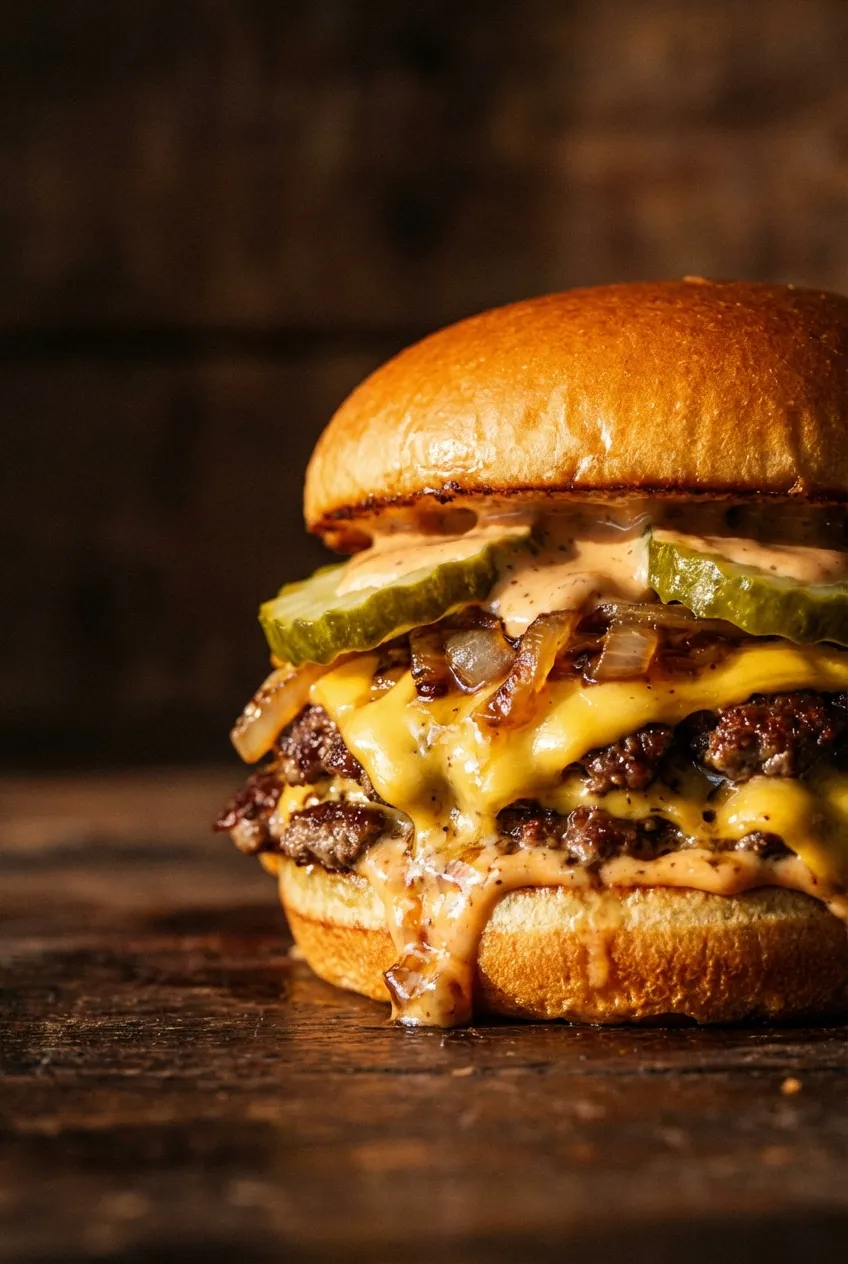
The Story Behind This Recipe
I’ll be honest with you — I spent twenty years chasing smoke. Low and slow, twelve-hour briskets, competition-grade ribs with a bark so thick you could tap it like a drum. That’s my world, and I love it. But the burger that changed my life didn’t come off a smoker. It came off a flat-top griddle in a cinder block shack outside Memphis, cooked by a man named Roosevelt who’d been making the same burger the same way since 1974.
Roosevelt didn’t do anything fancy. He had a ball of ground chuck, a hot griddle, and a coffee can full of rendered beef tallow he kept on the back burner. He’d drop a spoonful of that tallow on the griddle, set the beef ball down, press it flat with the back of a cast iron skillet, and walk away. Ninety seconds later, he’d flip it — and the underside looked like a piece of dark brown lace. Shatteringly crispy. Almost burnt, but not quite. That edge between caramelization and carbon is where all the magic lives, and Roosevelt knew exactly where that line was.
I went back to that shack every Saturday for three months, studying what he did. The secret wasn’t a special blend or a secret seasoning. It was the tallow. Beef tallow has a smoke point north of 400°F, and it adds this deep, round, beefy richness that butter and vegetable oil can’t touch. When that tallow hits a screaming hot cast iron and the beef smashes into it — you get a crust that no restaurant chain can replicate. I’ve been making these at my smokehouse ever since, and they outsell everything on the menu every single Friday night. Roosevelt passed away a few years back, but every time I press a burger flat and hear that sizzle, I think of him.
Before You Start
A few things that will make or break this burger:
- Keep the beef cold. Pull the ground chuck from the fridge right before forming the balls. Cold fat + screaming hot pan = maximum crust. If the fat is warm when it hits the griddle, you’ll steam instead of sear.
- Use a heavy press. A stiff, wide metal spatula is the minimum. A burger press or the bottom of a small cast iron skillet is even better. You need serious, even pressure to smash the ball flat in one motion.
- Don’t touch it after the smash. Once it’s flat, walk away. No poking, no pressing again, no adjusting. Let the Maillard reaction do its thing undisturbed.
- Get your mise en place ready. These cook fast — 90 seconds per side. Have your cheese sliced, onions ready, buns toasted, and toppings laid out before the first burger hits the pan.
- Ventilation matters. Beef tallow at 450°F will produce smoke. Turn on your range hood or open a window. This is not a gentle cooking process.
Instructions
Step 1: Form the Beef Balls
Divide 1 pound of ground chuck into eight equal portions (about 2 ounces each). Gently roll each portion into a loose ball — don’t compact them tightly. You want them just holding together. Overworking the meat makes the patties tough instead of tender. Place the balls on a plate and return them to the fridge while you prep everything else.
Step 2: Prep the Toppings & Toast the Buns
Slice the onion into thin rings. Separate the pickle chips and lay them out. If using lettuce and tomato, prep those too.
Set a 12-inch cast iron skillet over medium heat. Add about ½ teaspoon of beef tallow and let it melt. Place the brioche buns cut-side down in the skillet and toast for 60–90 seconds until golden brown. The tallow gives the buns a subtle beefy richness that ties the whole burger together. Remove and set aside. Wipe the skillet clean with a paper towel (careful — it’s hot).
Step 3: Heat the Skillet
Crank the heat to high and let the skillet heat for 3–4 minutes. You want the surface absolutely screaming — around 450–500°F (230–260°C). If you have an infrared thermometer, use it. If not, flick a drop of water onto the surface. It should evaporate instantly with an angry hiss, not dance around.
Add 1 tablespoon of beef tallow to the skillet and swirl to coat. The tallow should shimmer immediately and you’ll see the faintest wisps of smoke. That’s your signal.
Step 4: Smash the Burgers (First Batch)
Place four beef balls onto the skillet, spacing them evenly. Immediately — within 5 seconds of placing them — press each ball firmly and flatly with your burger press or the bottom of a small skillet. Press straight down with steady, even pressure for a full 5 seconds. You want them as thin as possible — about ¼ inch thick with ragged, lacy edges.
Season the tops generously with kosher salt and freshly ground black pepper. Do not touch them again.
Step 5: The First Flip
Cook undisturbed for 90 seconds to 2 minutes. The edges will start to look dark brown and crispy, and you’ll see the Maillard reaction climbing up the sides of the patty. When you slide a spatula underneath, the patty should release cleanly with a deeply caramelized, almost mahogany-colored crust on the bottom.
Flip each patty. Immediately place one slice of American cheese on each. If you’re doing the Oklahoma-style onion smash, drop a small pile of sliced onions on top of two of the patties before adding the cheese — the onions will steam and caramelize into the beef.
Cook for another 60 seconds on the second side. The cheese should be melted and bubbling at the edges.
Step 6: Stack the Doubles
Here’s where it comes together. Take one cheesed patty and stack it directly on top of another cheesed patty — cheese sides facing each other, creating a double-stack with melted cheese in the middle. You now have two double burgers. Transfer them to a plate and tent loosely with foil.
Add another ½ tablespoon of tallow to the pan and repeat Steps 4–6 with the remaining four beef balls to make two more double burgers.
Step 7: Assemble & Serve
Place each double-stack on a toasted brioche bun bottom. Layer on the caramelized onions, a few dill pickle chips, and lettuce and tomato if using. Crown with the bun top.
Serve immediately. These burgers wait for no one — the crust softens by the minute. Eat them standing over the counter if you have to. That’s how Roosevelt would have wanted it.
Ingredient Substitutions
| Ingredient | Substitute | Notes |
|---|---|---|
| Beef tallow | Clarified butter (ghee) or duck fat | Ghee works well but lacks the beefy depth. Duck fat adds richness but a different flavor profile. Avoid vegetable oil — the whole point is animal fat flavor. |
| 80/20 ground chuck | Ground brisket or a 70/30 blend | Brisket has deeper flavor. 70/30 is fattier and even crispier, but messier. Never go leaner than 80/20. |
| American cheese | Cheddar, pepper jack, or Gruyère | American melts the best — it’s engineered for it. Cheddar is sharper but won’t drape as smoothly. |
| Brioche buns | Martin’s potato rolls or pretzel buns | Martin’s is the classic smash burger bun — soft, slightly sweet, holds up to juices. Pretzel buns add a chewier texture. |
| Dill pickles | Bread-and-butter pickles or pickled jalapeños | Bread-and-butter adds sweetness. Jalapeños add heat. Both work beautifully. |
| Yellow onion | White onion or shallots | White onion is milder. Shallots caramelize faster and add a slightly sweet, complex flavor. |
| Butter lettuce | Iceberg lettuce | Iceberg has more crunch. Butter lettuce is more delicate and won’t compete with the burger. |
Chef’s Tips
- The tallow is non-negotiable. I know some people want to sub in butter or olive oil. Don’t. Beef tallow is what makes this a beef tallow smash burger. It has a higher smoke point than butter, won’t burn at the temperatures you need, and adds a layer of beefy umami that nothing else replicates. You can render your own by slowly cooking beef fat trimmings over low heat, or buy it pre-rendered at most butcher shops.
- Two ounces, not four. The whole point of a smash burger is maximum crust-to-meat ratio. A 4-ounce patty gives you a thick, steakhouse-style burger — delicious, but not what we’re after. Two-ounce balls smashed thin give you those shatteringly crispy, lacy edges that are the entire reason this burger exists. Double them up for substance.
- Don’t clean the skillet between batches. Those brown bits — the fond — are concentrated flavor. The second batch cooks in the accumulated tallow and beef drippings from the first, and they’re actually better for it.
- Season after the smash, not before. If you season the ball before smashing, the salt ends up trapped inside where it can’t do its job. Season the exposed top surface right after pressing so the salt hits your tongue first on every bite.
- Let American cheese be American cheese. I know food snobs will tell you to use aged cheddar or Gruyère. Ignore them. American cheese was literally designed to melt. It drapes over the patty like a blanket, gets into every crevice, and creates that gooey, pull-apart quality that makes a smash burger a smash burger.
- The bun matters more than you think. A toasted brioche in beef tallow is a game-changer. It adds structural integrity so the bun doesn’t disintegrate from the juices, and that thin layer of beefy fat on the cut surface ties the whole thing together.
Meal Prep & Storage
These burgers are best eaten immediately — the crispy crust is the whole point, and it doesn’t survive storage well. That said:
- Storage: Cooked patties can be stored in an airtight container in the fridge for up to 3 days. Separate patties with parchment paper to prevent sticking.
- Reheating: Reheat patties in a hot skillet with a small amount of tallow for 60–90 seconds per side to re-crisp the exterior. The microwave will make them rubbery — avoid it.
- Freezing: Uncooked beef balls freeze beautifully for up to 3 months. Place them on a parchment-lined sheet pan, freeze until solid, then transfer to a freezer bag. Cook directly from frozen — add an extra 30 seconds per side.
- Batch cooking: You can pre-portion and roll the beef balls up to 24 hours ahead and keep them covered in the fridge. This actually helps them hold their shape better during the smash.
Pairing Suggestions
- Beer: A cold American lager — Budweiser, Miller High Life, or a local pilsner. Nothing fancy. The simplicity of the beer lets the burger be the star. If you want something with more body, an amber ale works too.
- Side: Beef tallow french fries are the obvious move. Cut russet potatoes into ¼-inch sticks, double-fry in tallow at 300°F (150°C) then 375°F (190°C), and season with flaky salt. Crispy, golden, and insanely good.
- Slaw: A tangy, vinegar-based coleslaw cuts through the richness of the burger perfectly. Shredded cabbage, apple cider vinegar, a pinch of sugar, and celery seed.
- Shake: A thick vanilla milkshake. Classic burger-and-shake energy. Blend vanilla ice cream with whole milk until just barely pourable.
Frequently Asked Questions
Where do I buy beef tallow? Most butcher shops sell rendered beef tallow, and it’s increasingly available at grocery stores in the cooking oil aisle — brands like Epic and Fatworks are widely distributed. You can also render your own: ask your butcher for beef suet or fat trimmings, cut them into small pieces, and cook them in a heavy pot over low heat for 2–3 hours until the fat is liquid and the solids are golden. Strain through cheesecloth and store in a jar. It keeps for months in the fridge.
Can I make these on an outdoor griddle or grill? An outdoor flat-top griddle (like a Blackstone) is actually the ideal surface — tons of heat, plenty of space, and no smoke filling your kitchen. A regular grill with grates won’t work because the meat falls through and you can’t get the flat-surface contact needed for the crust.
Why two thin patties instead of one thick one? Surface area. A smash burger is all about the Maillard reaction — the chemical process that creates that deeply browned, almost caramelized crust. Two thin patties give you roughly double the crust compared to one thick patty, and the slice of cheese between them keeps everything juicy and held together.
My burgers stuck to the pan. What went wrong? Either the pan wasn’t hot enough or there wasn’t enough tallow. The skillet needs to be at 450–500°F (230–260°C) before the first burger hits it, and you need a visible coating of tallow on the surface. Also, don’t try to flip too early — if the patty sticks, it’s not ready. Give it another 15–20 seconds and it will release on its own.
Can I use a non-stick pan? I’d strongly advise against it. Most non-stick coatings aren’t rated for the temperatures you need here (450°F+), and even those that are won’t give you the same crust development. Cast iron or carbon steel is the way to go. The tallow provides all the non-stick properties you need.
Is beef tallow healthy? Beef tallow is a traditional cooking fat that’s been used for centuries. It’s high in saturated fat but also contains fat-soluble vitamins (A, D, E, K) and has a favorable fatty acid profile compared to many seed oils. It’s stable at high heat and doesn’t oxidize easily. As with any fat, use it in moderation — but a tablespoon or two for searing burgers is not going to derail anyone’s diet.